Security Intelligence
Event Security Planning: A Practical Guide for Corporate Event Organisers
Corporate events carry security risks that most organisers underestimate. This guide covers threat assessment, crowd management, VIP protection, and what to ask your security provider.
Written by James Whitfield — Senior Security Consultant
A corporate conference goes ahead without incident. A product launch runs smoothly. The investors leave, the team debrief, and nobody thinks about security until the next event. This is the normal outcome. It is also, sometimes, the result of luck rather than planning.
Good event security planning is largely invisible when it works. The incidents that make it visible happen when it is absent or poorly executed.
Starting Point: The Threat Assessment
Event security planning begins with a threat assessment, not a headcount. The question is not “how many people are attending?” The question is “what could go wrong, and what is the probability and impact of each scenario?”
A functional threat assessment for a corporate event covers:
Attendee profile risk. Does the event include high-profile individuals, public figures, executives from contested industries, or people likely to attract hostile attention? An investor conference with a prominent keynote speaker carries different risks to an internal training day.
Event content sensitivity. Is the content politically or commercially sensitive in the host country or jurisdiction? An event covering topics sensitive to the host government, or involving industries under activist attention, increases the probability of protest or disruption.
Venue and location risk. Is the venue in a high-crime area? Is it in a city where the general security environment requires specific measures? The event security operation for a conference in London is materially different from the same conference in Lagos or Bogota. Our event security in London and event security in Lagos briefs cover city-specific considerations in detail.
Access control risk. Is this a closed event (controlled attendee list, credentialled access) or an event with public elements? Events with public access carry higher baseline risk because the threat pool is not bounded by an invitation list.
The threat assessment output drives the security design. A low-threat-profile event in a stable environment may require only basic access control and a small security presence. A high-threat-profile event in a complex environment requires a fully designed security operation.
The Security Plan
A professional event security provider will produce a written security plan before the event. An organiser who has not seen a written plan before the event has not yet engaged a professional provider.
The security plan covers:
Roles and responsibilities. Who is in command of the security operation? Who makes decisions if an incident occurs? What is the escalation chain? What is the interface between the security team and event management? Clarity on command and communication prevents the confusion that makes incidents worse.
Access control design. How will the perimeter be defined and maintained? What credentialling system is in use? Who has authority to grant access exceptions? What happens if an uninvited individual attempts entry? A specific individual is assigned to each access point, not a general instruction to “manage the door.”
Crowd management. For events above a certain size, movement management matters. Attendee flow routes, pinch points, and emergency evacuation paths are all determined in advance. The venue fire safety plan must be reviewed and the security team must be familiar with it. Emergency procedures are a legal requirement under the Regulatory Reform (Fire Safety) Order 2005 in England and Wales.
VIP protection. If any attendee warrants a higher level of protection than general event security provides, this is planned as a separate operation within the overall security plan. See the section below.
Incident response. What happens if a medical emergency occurs? What if a hostile individual is identified? What if a threat is received before the event? What if an incident occurs in the city that changes the threat environment on the day of the event? Each scenario requires a specific response plan, not improvisation.
Communications protocol. How do the security team, event management, venue security, and emergency services communicate? Radio channels, key contact numbers, and escalation triggers must be agreed and documented before the event.
VIP Protection at Events
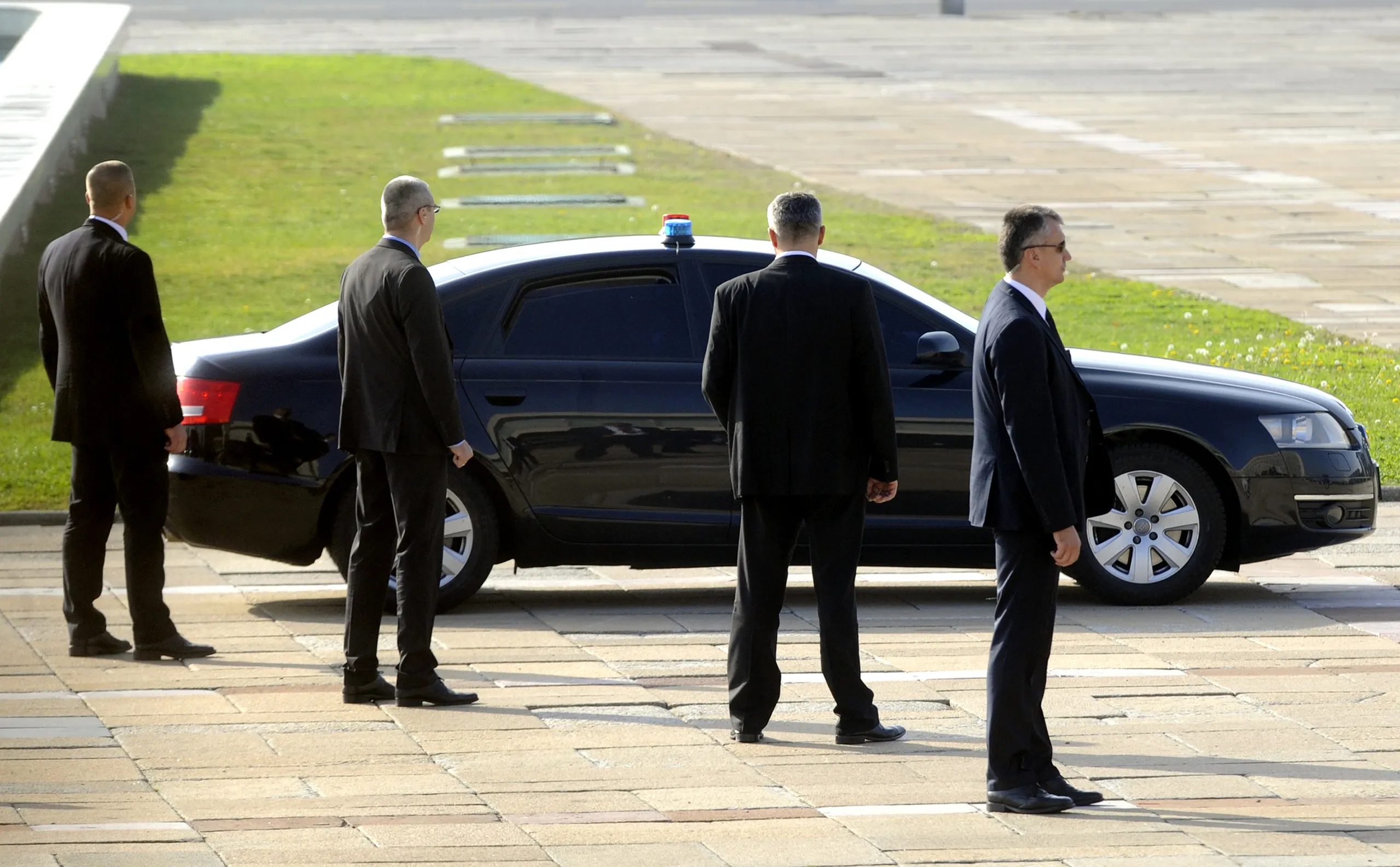
When a prominent attendee is present, their security cannot be handled as a sub-task within general event security. A dedicated close protection officer operates exclusively for that individual and is not called away to manage a queue or handle an access dispute.
The VIP protection plan includes:
Advance work at the venue. Before the VIP arrives, an officer surveys the venue from the VIP’s perspective: arrival point, holding area, stage access, private spaces, and departure route. Any issues are raised with the venue before the day.
Separate access route. The VIP does not use the main attendee entrance. A private access point, or a timed arrival that avoids peak attendee flow, separates the VIP from the general crowd and reduces exposure.
A dedicated holding area. A private space at the venue where the VIP can prepare, debrief, and wait without being accessible to the general attendee population. This is often a green room, an executive suite, or a private meeting room designated for this purpose.
Defined departure. VIP departure is planned before arrival. Time, route, and vehicle are confirmed in advance. Spontaneous departures following an event are one of the higher-risk moments for prominent individuals.
For events where executive protection services are required for attendees, the EP team and the event security operation must have a clearly defined interface. The CP officer’s primary responsibility is the principal, not the event. The event security team’s responsibility is the event environment.
Working with a Security Provider
The right security provider for a corporate event is not necessarily the largest or most expensive. The right provider is the one with demonstrable experience in the specific event type and environment.
Questions to ask when selecting a provider:
Can they demonstrate relevant experience? Previous events of a similar profile (size, attendee type, venue complexity, location) are a meaningful indicator. References from event organisers on comparable engagements carry more weight than general capability statements.
What licences do their officers hold? For events in the United Kingdom, door supervisor and access control roles require SIA Door Supervisor licences. Roles involving close protection of named individuals require SIA Close Protection licences. Confirm the relevant licensing before engagement.
What is their insurance position? Public liability insurance of at least £5 million is standard for event security providers. Request a current certificate before confirming any engagement.
What is their planning process? A provider who can describe a clear planning process, including venue assessment, security plan production, and pre-event briefings, is operating to professional standards. A provider who confirms team numbers without a planning conversation is not.
What do they do when something goes wrong? Ask directly. The answer reveals whether they have incident response protocols or whether they will improvise. Both outcomes are possible.
High-Risk City Events
Events in high-risk cities require additional layers of planning that domestic events do not.
The security assessment must incorporate city-level threat intelligence. The security team must include operators with current knowledge of the local operating environment. Where appropriate, local security resources with intelligence and relationships in the city should be integrated into the plan.
Accommodation and transport for attendees must meet security standards appropriate to the city. The route between hotel and venue is assessed, not assumed. Medical provisions at or near the venue are identified in advance.
Events in cities rated at high or critical risk by Control Risks, OSAC, or government advisory systems are not the same operational challenge as events in low-risk environments. The security design must reflect the actual threat environment, not the organiser’s familiarity with the format.
For the specialist considerations that apply when the event is a mass gathering – pilgrimages, large-scale public events, or gatherings of 50,000 or more – see our guide to security for pilgrimages and mass gatherings. For the specific security challenges of professional sports venues and major sporting events – crowd crush science, Martyn’s Law obligations for stadiums, NaCTSO hostile vehicle requirements, VIP protection coordination with venue security, and P1 city sports environments – see our stadium security and major sports events guide. For places of worship hosting large services, festivals, or high-profile religious events – where Martyn’s Law, hostile vehicle mitigation, and the open-access theological commitment all require specific event security planning – see our security for religious sites and places of worship guide. For late-night licensed premises – bars, nightclubs, and entertainment venues – where the SIA Door Supervisor licensing requirement, Licensing Act 2003 obligations, use-of-force legal framework, and Martyn’s Law terrorist threat assessment create a specific security and compliance requirement, see our security for alcohol and nightlife venues guide. For shopping centres, retail parks, and malls – Enhanced duty premises under Martyn’s Law, hostile vehicle mitigation at pedestrian entry points, organised retail crime escalation, and car park security standards – see our security for shopping centres and retail parks guide. For trade exhibitions and business events – competitive intelligence risks on the exhibition floor, device security at international trade shows including China events, VIP close protection in high-density exhibition halls, Martyn’s Law obligations for major venues and exhibitors, and exhibit theft prevention – see our security at trade exhibitions and business events guide. For organisations planning executive off-site events and corporate retreats – venue selection security criteria, advance work for remote locations, attendee data protection, group transport security, protest and activist risk, and medical planning at isolated venues – see our security planning for corporate retreats and off-site events guide. For professional sports teams and club security managers planning international fixtures – NFIU and Europol hooligan intelligence, team transport and accommodation security, player KFR risk in P1 cities, social media OPSEC, and MEDEVAC planning for away fixtures – see our security for sports teams on international travel guide. For touring music productions and live event security – where venue advance operations, Martyn’s Law obligations for UK concerts, crowd safety integration post-Astroworld, and artist transit security in P1 city markets require a distinct operational framework – see our security for music tours and live event productions guide.
Key takeaways
The venue assessment determines the security design, not the other way around
Security planning that starts with a team size and works backwards to a venue is backwards. The venue assessment identifies what threats exist and what the physical environment allows. Security design follows from that. Organisers who confirm venue and team size before conducting a proper assessment are likely to end up under-resourced in some areas and over-resourced in others.
VIP protection is a separate operation, not a sub-task
Assigning a general event security officer to look after a prominent speaker during their time at the venue is not a VIP protection plan. A proper VIP protection operation requires a dedicated officer, a separate access route, advance work, and a defined departure plan. Merging it with general event security creates conflicts between the two tasks.
Brief all staff, not just the security team
Event security breaks down at the points where non-security staff interact with the operation. Registration staff, AV crews, catering, and venue staff are all part of the security perimeter. A 30-minute briefing covering what to watch for, who to call, and what not to do significantly improves the effectiveness of the professional security team.
Frequently Asked Questions
Request a Consultation
Describe your security requirements below. All enquiries are confidential and handled by licensed consultants.
Your enquiry has been received. A security consultant will contact you within 24 hours to discuss your requirements.